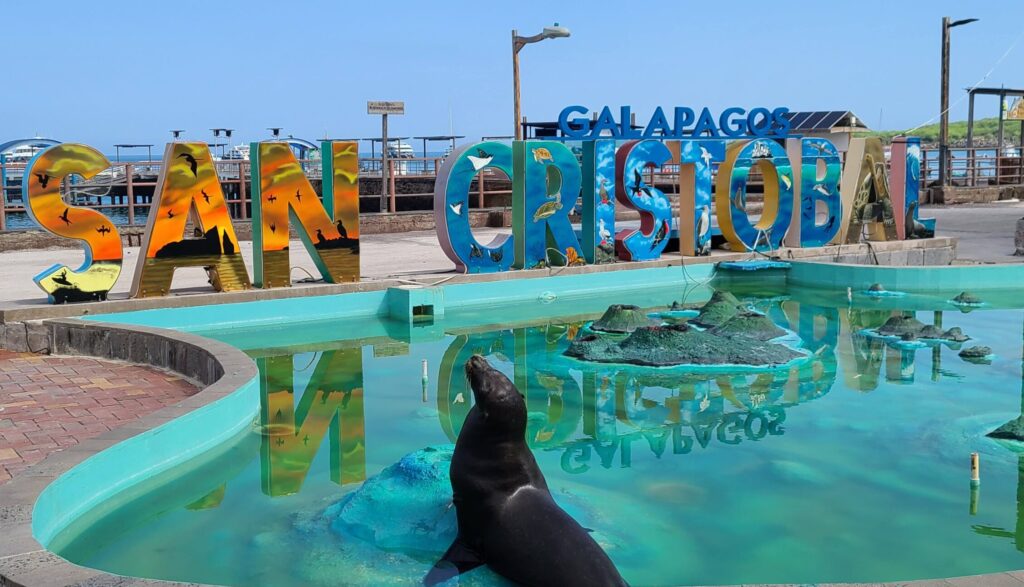
These are our best tips to help you prepare for a trip to the Galapagos islands.
So you’ve made the big decision to visit the Galapagos Islands—and now you’re trying to figure out how everything actually works.
Maybe you’re deciding between a cruise and an island-hopping trip. Maybe you’re planning everything yourself. Or maybe you’re doing a combination of the two.
Whatever your travel style, there are a few things about visiting Galapagos that aren’t necessarily obvious until you get here.
We’ve lived and worked in Galapagos for years, and we’ve traveled extensively throughout the islands. These are 10 Galapagos travel tips we think every visitor should know before arriving.

1. Bring cash—and plenty of small bills
Ecuador uses the US dollar as its official currency, and cash is still extremely useful in Galapagos. Bring plenty of $5, $10 and $20 bills. Smaller businesses often don’t have enough change for large bills or don’t accept them period.
Credit and debit cards are increasingly accepted, especially at larger hotels, restaurants and businesses, but you should not assume that you can use a card everywhere. ATMs are also available on the inhabited islands, but access and reliability can vary. Most tour operators will add a fee if you pay with a credit card and often it’s 15%. That’s apart from whatever fee your card might charge for an international transaction, which still applies even though it’s in US dollars.
On San Cristobal, the majority of ATMs are owned by Banco del Pacifico. Their machines accept most foreign debit cards, but have a $200 per transaction withdrawal limit (you can withdraw no more than $600 in one day no matter how many different Pacifico machines you use) and charge a $4.60 fee per transaction. There is also a Banco Pichincha ATM at city hall and a credit union ATM on the side street by the police station. On Santa Cruz you’ll have more options, including three different ATM machines outside the Proinsular Market near the main dock. Isabela is even more limited than San Cristobal, with two Banco del Pacifico ATMs on the main square.
Our advice: Don’t arrive in Galapagos planning to rely entirely on your credit card or ATM. And remember that you’ll need cash for things such as water taxis, small restaurants, local transportation and tips.
Don’t forget the Galapagos entry fees
There are two different fees that travelers commonly confuse:
- Transit Control Card (TCT): $20 per person: The TCT is a separate immigration/control requirement for visitors entering Galapagos. You can complete the preregistration process online before traveling.
- Galapagos National Park conservation fee: currently $200 for international visitors over age 12

2. Know What to Expect from Medical Care in Galapagos
San Cristóbal and Santa Cruz each have one public hospital, but medical facilities on the islands are limited. A few doctors and nurses speak some English, but you should not expect the same level of medical care or specialist services that you would find in mainland Ecuador or in your home country. Isabela’s hospital is essentially a clinic. If you need stitches or treatment for a minor illness or injury, you should be able to receive adequate care, although you will generally need to pay for medications and basic medical supplies.
Anything more serious will probably require travel to mainland Ecuador. If your condition is serious but not life-threatening, you may need to purchase a regular seat on a commercial flight. In a life-threatening emergency, evacuation may be arranged through the Ecuadorian military or via private jet.
If a serious medical emergency occurs on another inhabited island, you may first be transported to the hospital in San Cristóbal for evaluation and stabilization. If emergency evacuation to the mainland is considered necessary, the patient may be transported by an Ecuadorian Navy aircraft to Guayaquil and then transferred to a hospital there. Keep in mind that there is limited capacity for this type of emergency evacuation, and the decision about whether a patient qualifies for evacuation is made by the appropriate local medical and government authorities.
The bottom line: No matter your age or general health, travel medical insurance that includes emergency evacuation coverage is highly recommended when visiting Galapagos. Also, make sure you have the emergency contact information for your home country’s embassy or consulate in Ecuador, or its citizen-services office. In a worst-case emergency, they may be able to provide important assistance and guidance.
Pharmacies and prescription medications
San Cristóbal, Santa Cruz and Isabela all have pharmacies, and many common medications are available without a prescription. However, pharmacy hours are limited. Only one pharmacy typically operates overnight on a rotating schedule, so if you need medication outside normal business hours, you’ll need to ask locally which pharmacy is on duty.
More importantly, don’t assume that a specialty medication will be available in Galapagos. If you take prescription medication regularly, bring enough for your entire trip—and I strongly recommend bringing extra in case of travel delays or other unexpected circumstances.
Don’t put your essential medications in checked luggage. Keep them with you.

3. Sun protection is a must.
The equatorial sun is intense—even when it doesn’t feel particularly hot. Don’t make the mistake of thinking that an overcast or drizzly day means you’re not getting significant sun exposure. We recommend:
- Reef-conscious sunscreen
- Lightweight long-sleeved shirts
- Sun-protective clothing
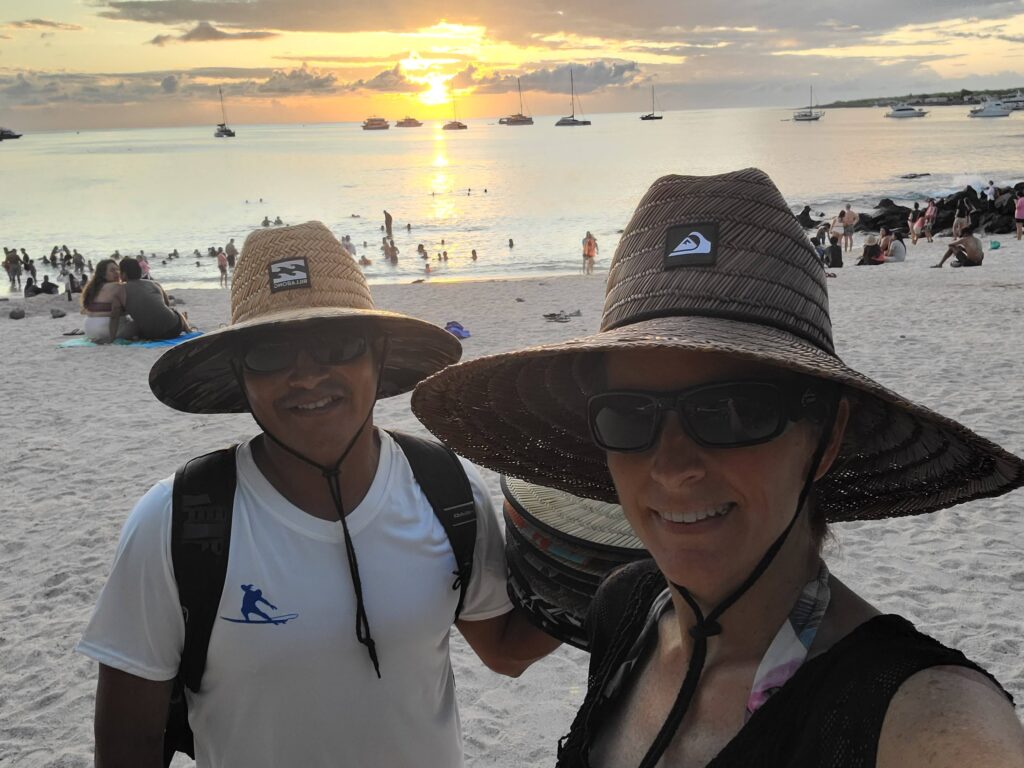
- A wide-brimmed hat
- Sunglasses
- Reapplying sunscreen after swimming or snorkeling
And don’t forget the places people commonly overlook: your ears, feet, neck and the backs of your hands.
Our Galapagos Surf discovery branded apparel is a great addition to your island-hopping wardrobe. Check out our Galapagos packing list for more tips on what to bring for your island vacation.

4. Consider flying into one island and out of another
If you’re visiting Galapagos for more than a few days, don’t automatically assume that you need to fly round-trip through the same island. Depending on your itinerary, it can make much more sense to fly into one island and depart from another.
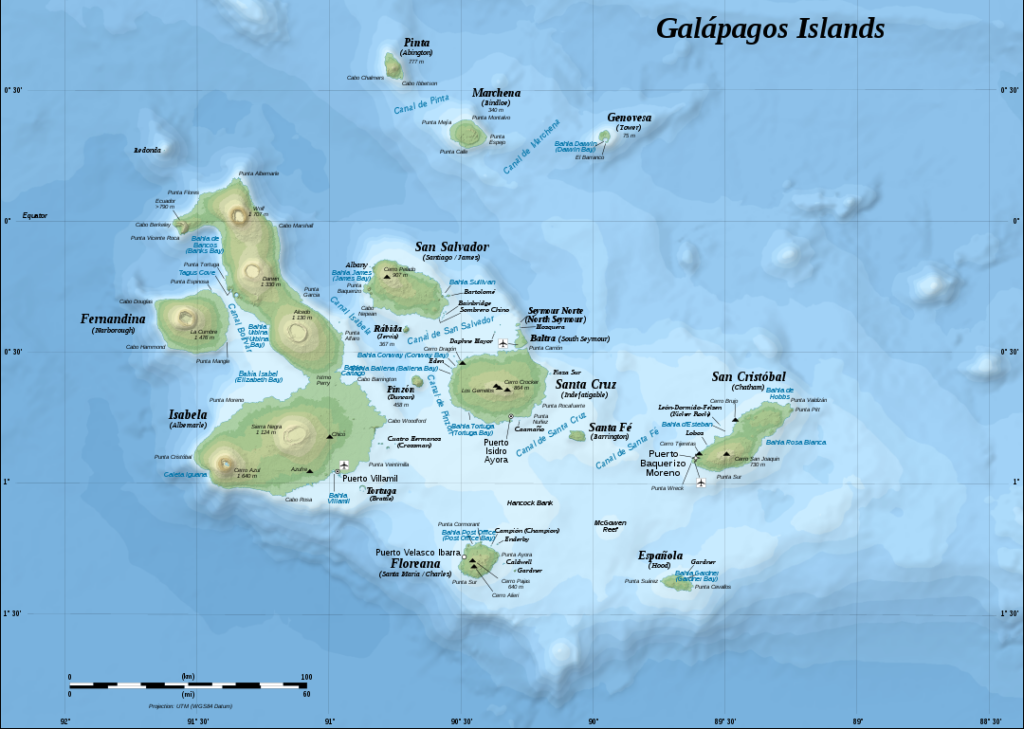
For example, one of our recommended itineraries is: Quito → San Cristobal → Isabela → Santa Cruz → Quito
Or, plan your inbound flight around a cruise, followed by land-based activities and a flight out from another island.
This can save considerable time and eliminate unnecessary backtracking.
San Cristobal vs. Baltra
Pay close attention when booking flights.
San Cristobal Airport (SCY) is located just minutes from Puerto Baquerizo Moreno.
Baltra Airport (GPS) is on a separate, uninhabited island north of Santa Cruz. Getting from Baltra Airport to Puerto Ayora requires several steps, including transportation across the Itabaca Channel.
This is one reason why the cheapest flight isn’t necessarily the cheapest or easiest option once you consider the entire itinerary.
You can read more about transportation in our post about Galapagos trip costs.

5. Galapagos ferries are not what you think
This may be the biggest misconception about traveling between the islands.
The so-called inter-island “ferries” are actually speedboats, not traditional ferries. They’re practical and relatively inexpensive—but they can also be uncomfortable, particularly when the ocean is rough.
There is generally:
- No assigned seating
- No traditional ferry-style amenities
- Limited space
- No comfortable place to walk around
- No guarantee that the sea will be calm
And yes, seasickness is common. If you’re prone to motion sickness—or simply don’t know how you’ll react—take it seriously.
For some travelers, particularly those traveling between San Cristobal and Isabela, an inter-island flight can be well worth the additional cost and can save a significant amount of travel time.
We have a separate guide explaining more about the Galapagos Ferries: Routes, Schedules, Prices & What to Expect.

6. Tipping is appreciated, but it’s not mandatory
Tipping is customary for good service on organized tours and cruises, but it is not mandatory.
If you’ve received excellent service, a cash tip is a nice way to show your appreciation. The amount can vary depending on the length and type of activity and the level of service.
Our tipping suggestions are as follows:
- Guide or tour leader or assistant on half-day tours and other shorter activities: $5-10 per person
- Naturalist guide on full day activity/day trips: $10 per person
- Crew on boats (there will be a communal tip jar for entire crew): $5-10 per person
- Chauffeurs i.e. drivers for private tours $10 (total, not per person); it is not common to tip taxi drivers unless they help you with a lot of luggage
For anyone who goes out of their way to help or has to do more work to cater to your needs/interests or helps care for kids or less mobile travelers, please adjust accordingly.
Tipping is not common in local restaurants, bars, etc. but if you are pleased with the service provided, feel free to round up the bill to the nearest dollar or leave a maximum of 10% of the total bill. Note that many upscale restaurants and hotels automatically add a service fee to the bill. You’ll see IVA 15% (that’s the sales tax) and Servicio 10% (that’s the tip). So no need to add more in that case!
And remember: if you want your tip to go to a particular person, give it to them directly.

7. Don’t Expect to Negotiate Galapagos Tour Prices
Rates for day trips and other activities are usually set at the beginning of every year. Adjustments may be made if prices need to increase due to factors beyond the operators’ control, such as government-mandated increases in fuel prices or unexpected increases in supply costs. For example, when a cargo ship gets damaged, Galapagos experiences a months-long shortage of just about everything, which has a significant impact on operating costs.
For the most part, day tour and activity prices are not negotiable. Occasionally, you’ll see a range of prices for the same general day trip because there are luxury or first-class yachts that operate certain itineraries. Unless you are specifically reserving a spot on one of those boats, or booking a unique itinerary that is different from the norm, the price for a standard day trip should be relatively similar no matter which agency you book with.
However, there is an important distinction between the operator’s price and the price charged by a travel agency. In our experience, online resellers like Viator are often at least 25% more expensive than buying from a Galapagos-based agency, while prices between local agencies can vary by $10–$20 for the exact same boat and itinerary.
So, in that sense, the price may be “negotiable.” But remember: you get what you pay for.
What about last-minute cruise discounts?
Cruises are different. You may be able to get a significant discount on the normal price of a cruise in the week or two before departure if there are still spaces available. However, this generally applies only to one or two passengers, is much less likely during peak travel periods such as December/January, and requires you to be extremely flexible with your travel dates and flights.
Even with a last-minute discount, don’t expect a Galapagos cruise to be cheap. You should still budget around $3,000 per person or more for a week-long cruise, depending on the boat and itinerary. And remember to account separately for flights, the Galapagos National Park entry fee, tips, transportation and other expenses.
For a more complete breakdown, see our guide to Galapagos trip costs.
Consider booking with a local Galapagos travel agency
One other thing you should know when comparing prices online: the vast majority of travel agencies selling package tours to Galapagos are based in Quito, elsewhere in Ecuador, or in another country entirely. That doesn’t necessarily mean you shouldn’t book with them. But keep in mind that some agencies are selling activities, hotels and other services that they have never personally experienced or vetted.
If something doesn’t go according to plan, do they have someone on the ground in Galapagos who can help you?
We’re not saying that you absolutely shouldn’t book with an agency based elsewhere. Just consider how much of the money you’re spending may actually benefit businesses and people in Galapagos.
As with anything, do your research. Check reviews. Make sure you’re communicating directly with an owner or an authorized representative and ask them to provide their current operating permits. And make sure the payment, cancellation and refund terms are clearly explained on the company’s website and in your written communications.
Whenever possible, buy directly from local travel agencies and tour operators.
8. Be honest about your experience and physical ability
This is important for both your safety and the safety of the people traveling with you.
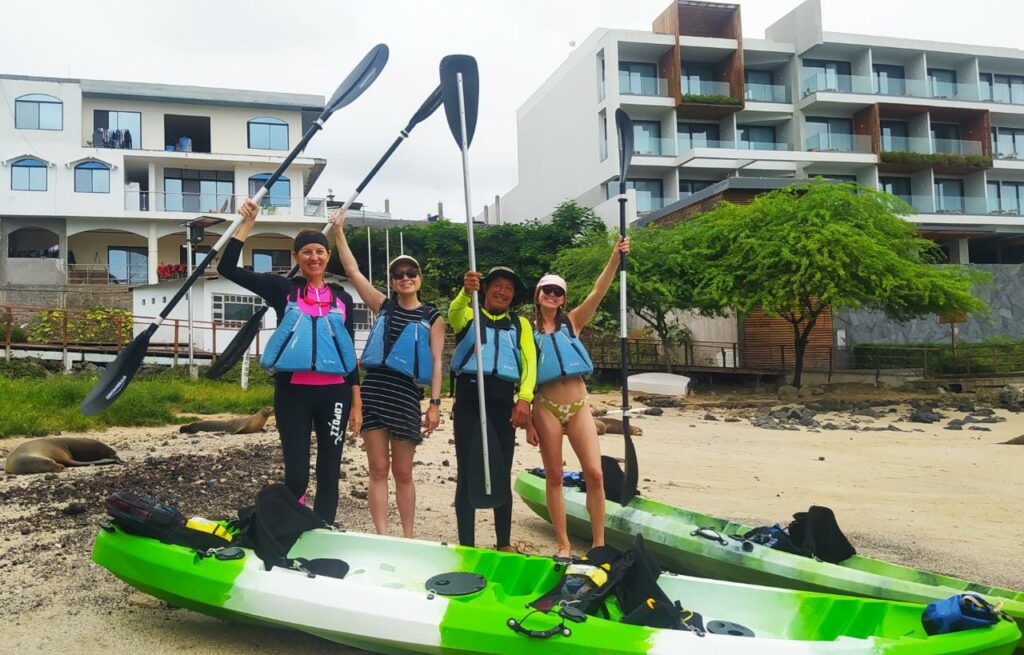
If a tour operator asks whether you can swim, snorkel, kayak, hike, surf or participate in another physical activity, answer honestly.
Don’t tell someone you’re a strong swimmer if you haven’t been in the water for years.
Don’t say you’ve snorkeled extensively if you’ve only tried it once.
And if you have physical limitations, injuries or other concerns that could affect your participation, tell the operator before booking, not when you’re standing on the beach.
This allows the operator to determine whether the activity is appropriate, whether additional safety support is needed, and whether another activity might be a better choice.
The same applies to motion sickness. Tell your tour operator and guide in advance.
9. Learn the Galapagos National Park rules before you arrive
This isn’t optional—and it isn’t simply about avoiding a fine.
The Galapagos Islands are a protected ecosystem, and visitors have a responsibility to minimize their impact.
Some of the most important rules include:
- Maintain the required distance from wildlife.
- Never touch, feed or chase animals.
- Stay on designated trails.
- Don’t remove rocks, shells, plants or other natural objects.
- Don’t introduce food, plants, animals or other prohibited organic materials between islands.
- Follow your naturalist guide’s instructions.
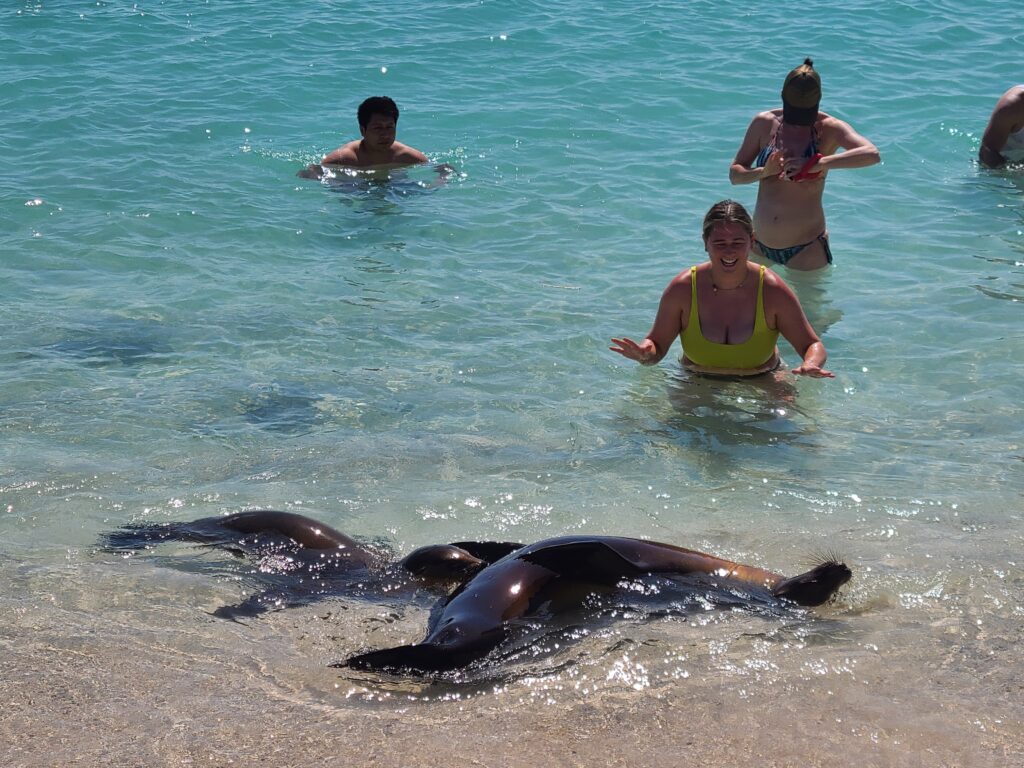
One of the most common problems we see is visitors getting too close to wildlife because the animal approaches them. If a sea lion comes toward you, you don’t get closer because you want a better photo. You move away and give the animal space.
That’s part of responsible tourism.

10. Don’t let the weather forecast ruin your trip
Galapagos weather is unpredictable. You can have clouds, sun, wind, and rain all in the same day. A weather app isn’t going to tell you exactly what conditions will be like at your particular beach, trail or snorkeling site several days in advance.
Instead of trying to find the mythical “perfect” weather window, understand that Galapagos has different seasonal patterns and there is no single best time of year for everyone to visit.
The best time to come is often simply when you can come. And when you get here, my best advice is:
Go with the flow. Your trip to Galapagos isn’t supposed to be perfectly predictable. That’s part of what makes being here special. Put down your phone. Get off the internet. Talk to someone who lives here. Order a drink. Ask them about island life. You might learn something that isn’t in any guidebook.
One Bonus Tip: Leave Some Room in Your Itinerary
I’m adding an 11th tip because it’s too important not to mention: Don’t over-schedule yourself.
It’s tempting to look at a map of Galapagos and think, “I want to see everything!” But moving between islands takes time. Ferries can be delayed. Flights can change. And sometimes the best part of a trip is simply having a morning with nowhere to be.
If you have only five days, don’t try to visit all four inhabited islands. If you have two weeks, you have much more flexibility. And if you’re combining a cruise with a land-based stay, plan carefully so that your transportation and activities actually work together.
Planning Your Galapagos Trip?
Learn more about our Galapagos Travel Consulting
We live and work in Galapagos, and we’ve traveled extensively throughout the islands. We’ve been on cruises, visited the major day-trip destinations, and—perhaps most importantly—we deal with the practical realities of traveling around Galapagos every day.
If you’re planning an independent island-hopping trip and need help putting the pieces together, we can help coordinate transportation, accommodations, tours, activities and other logistics.
We don’t just want to sell you a tour. We want to help you build an itinerary that makes sense for the time you have and the kind of experience you want.
Is this website helpful for planning a trip to Galapagos? You can show your appreciation by clicking here.